Indefinite inner product space
In mathematics, in the field of functional analysis, an indefinite inner product space
- (K,⟨⋅,⋅⟩,J){displaystyle (K,langle cdot ,,cdot rangle ,J)}

is an infinite-dimensional complex vector space K{displaystyle K} equipped with both an indefinite inner product

- ⟨⋅,⋅⟩{displaystyle langle cdot ,,cdot rangle ,}

and a positive semi-definite inner product
- (x,y) =def ⟨x,Jy⟩,{displaystyle (x,,y) {stackrel {mathrm {def} }{=}} langle x,,Jyrangle ,}
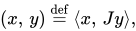
where the metric operator J{displaystyle J} is an endomorphism of K{displaystyle K} obeying

- J3=J.{displaystyle J^{3}=J.,}

The indefinite inner product space itself is not necessarily a Hilbert space; but the existence of a positive semi-definite inner product on K{displaystyle K} implies that one can form a quotient space on which there is a positive definite inner product. Given a strong enough topology on this quotient space, it has the structure of a Hilbert space, and many objects of interest in typical applications fall into this quotient space.
An indefinite inner product space is called a Krein space (or J{displaystyle J}-space) if (x,y){displaystyle (x,,y)} is positive definite and K{displaystyle K} possesses a majorant topology. Krein spaces are named in honor of the Soviet mathematician Mark Grigorievich Krein (3 April 1907 – 17 October 1989).

Contents
1 Inner products and the metric operator
2 Properties and applications
3 Isotropic part and degenerate subspaces
4 Pontryagin space
5 Pesonen operator
6 References
Inner products and the metric operator
Consider a complex vector space K{displaystyle K} equipped with an indefinite hermitian form ⟨⋅,⋅⟩{displaystyle langle cdot ,,cdot rangle }. In the theory of Krein spaces it is common to call such an hermitian form an indefinite inner product. The following subsets are defined in terms of the square norm induced by the indefinite inner product:

K0 =def {x∈K:⟨x,x⟩=0}{displaystyle K_{0} {stackrel {mathrm {def} }{=}} {xin K:langle x,,xrangle =0}} ("neutral")
K++ =def {x∈K:⟨x,x⟩>0}{displaystyle K_{++} {stackrel {mathrm {def} }{=}} {xin K:langle x,,xrangle >0}} ("positive")
K−− =def {x∈K:⟨x,x⟩<0}{displaystyle K_{--} {stackrel {mathrm {def} }{=}} {xin K:langle x,,xrangle <0}} ("negative")
K+0 =def K++∪K0{displaystyle K_{+0} {stackrel {mathrm {def} }{=}} K_{++}cup K_{0}} ("non-negative")
K−0 =def K−−∪K0{displaystyle K_{-0} {stackrel {mathrm {def} }{=}} K_{--}cup K_{0}} ("non-positive")



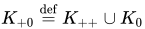
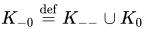
A subspace L⊂K{displaystyle Lsubset K} lying within K0{displaystyle K_{0}} is called a neutral subspace. Similarly, a subspace lying within K+0{displaystyle K_{+0}} (K−0{displaystyle K_{-0}}) is called positive (negative) semi-definite, and a subspace lying within K++∪{0}{displaystyle K_{++}cup {0}} (K−−∪{0}{displaystyle K_{--}cup {0}}) is called positive (negative) definite. A subspace in any of the above categories may be called semi-definite, and any subspace that is not semi-definite is called indefinite.


Let our indefinite inner product space also be equipped with a decomposition into a pair of subspaces K=K+⊕K−{displaystyle K=K_{+}oplus K_{-}}, called the fundamental decomposition, which respects the complex structure on K{displaystyle K}. Hence the corresponding linear projection operators P±{displaystyle P_{pm }} coincide with the identity on K±{displaystyle K_{pm }} and annihilate K∓{displaystyle K_{mp }}, and they commute with multiplication by the i{displaystyle i} of the complex structure. If this decomposition is such that K+⊂K+0{displaystyle K_{+}subset K_{+0}} and K−⊂K−0{displaystyle K_{-}subset K_{-0}}, then K{displaystyle K} is called an indefinite inner product space; if K±⊂K±±∪{0}{displaystyle K_{pm }subset K_{pm pm }cup {0}}, then K{displaystyle K} is called a Krein space, subject to the existence of a majorant topology on K{displaystyle K} (a locally convex topology where the inner product is jointly continuous).



The operator J =def P+−P−{displaystyle J {stackrel {mathrm {def} }{=}} P_{+}-P_{-}} is called the (real phase) metric operator or fundamental symmetry, and may be used to define the Hilbert inner product (⋅,⋅){displaystyle (cdot ,,cdot )}:


- (x,y) =def ⟨x,Jy⟩=⟨x,P+y⟩−⟨x,P−y⟩{displaystyle (x,,y) {stackrel {mathrm {def} }{=}} langle x,,Jyrangle =langle x,,P_{+}yrangle -langle x,,P_{-}yrangle }

On a Krein space, the Hilbert inner product is positive definite, giving K{displaystyle K} the structure of a Hilbert space (under a suitable topology). Under the weaker constraint K±⊂K±0{displaystyle K_{pm }subset K_{pm 0}}, some elements of the neutral subspace K0{displaystyle K_{0}} may still be neutral in the Hilbert inner product, but many are not. For instance, the subspaces K0∩K±{displaystyle K_{0}cap K_{pm }} are part of the neutral subspace of the Hilbert inner product, because an element k∈K0∩K±{displaystyle kin K_{0}cap K_{pm }} obeys (k,k) =def ⟨k,Jk⟩=±⟨k,k⟩=0{displaystyle (k,,k) {stackrel {mathrm {def} }{=}} langle k,,Jkrangle =pm langle k,,krangle =0}. But an element k=k++k−{displaystyle k=k_{+}+k_{-}} (k±∈K±{displaystyle k_{pm }in K_{pm }}) which happens to lie in K0{displaystyle K_{0}} because ⟨k−,k−⟩=−⟨k+,k+⟩{displaystyle langle k_{-},,k_{-}rangle =-langle k_{+},,k_{+}rangle } will have a positive square norm under the Hilbert inner product.







We note that the definition of the indefinite inner product as a Hermitian form implies that:
- ⟨x,y⟩=14(⟨x+y,x+y⟩−⟨x−y,x−y⟩){displaystyle langle x,,yrangle ={frac {1}{4}}(langle x+y,,x+yrangle -langle x-y,,x-yrangle )}

(Note: This is not correct for complex-valued Hermitian forms. It only gives the real part.)
Therefore the indefinite inner product of any two elements x,y∈K{displaystyle x,,yin K} which differ only by an element x−y∈K0{displaystyle x-yin K_{0}} is equal to the square norm of their average x+y2{displaystyle {frac {x+y}{2}}}. Consequently, the inner product of any non-zero element k0∈(K0∩K±){displaystyle k_{0}in (K_{0}cap K_{pm })} with any other element k±∈K±{displaystyle k_{pm }in K_{pm }} must be zero, lest we should be able to construct some k±+2λk0{displaystyle k_{pm }+2lambda k_{0}} whose inner product with k±{displaystyle k_{pm }} has the wrong sign to be the square norm of k±+λk0∈K±{displaystyle k_{pm }+lambda k_{0}in K_{pm }}.



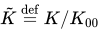
Similar arguments about the Hilbert inner product (which can be demonstrated to be a Hermitian form, therefore justifying the name "inner product") lead to the conclusion that its neutral space is precisely K00=(K0∩K+)⊕(K0∩K−){displaystyle K_{00}=(K_{0}cap K_{+})oplus (K_{0}cap K_{-})}, that elements of this neutral space have zero Hilbert inner product with any element of K{displaystyle K}, and that the Hilbert inner product is positive semi-definite. It therefore induces a positive definite inner product (also denoted (⋅,⋅){displaystyle (cdot ,,cdot )}) on the quotient space K~ =def K/K00{displaystyle {tilde {K}} {stackrel {mathrm {def} }{=}} K/K_{00}}, which is the direct sum of K~± =def K±/(K0∩K±){displaystyle {tilde {K}}_{pm } {stackrel {mathrm {def} }{=}} K_{pm }/(K_{0}cap K_{pm })}. Thus (K~,(⋅,⋅)){displaystyle ({tilde {K}},,(cdot ,,cdot ))} is a Hilbert space (given a suitable topology).



Properties and applications
Krein spaces arise naturally in situations where the indefinite inner product has an analytically useful property (such as Lorentz invariance) which the Hilbert inner product lacks. It is also common for one of the two inner products, usually the indefinite one, to be globally defined on a manifold and the other to be coordinate-dependent and therefore defined only on a local section.
In many applications the positive semi-definite inner product (⋅,⋅){displaystyle (cdot ,,cdot )} depends on the chosen fundamental decomposition, which is, in general, not unique. But it may be demonstrated (e. g., cf. Proposition 1.1 and 1.2 in the paper of H. Langer below) that any two metric operators J{displaystyle J} and J′{displaystyle J^{prime }} compatible with the same indefinite inner product on K{displaystyle K} result in Hilbert spaces K~{displaystyle {tilde {K}}} and K~′{displaystyle {tilde {K}}^{prime }} whose decompositions K~±{displaystyle {tilde {K}}_{pm }} and K~±′{displaystyle {tilde {K}}_{pm }^{prime }} have equal dimensions. Although the Hilbert inner products on these quotient spaces do not generally coincide, they induce identical square norms, in the sense that the square norms of the equivalence classes k~∈K~{displaystyle {tilde {k}}in {tilde {K}}} and k~′∈K~′{displaystyle {tilde {k}}^{prime }in {tilde {K}}^{prime }} into which a given k∈K{displaystyle kin K} falls are equal. All topological notions in a Krein space, like continuity, closed-ness of sets, and the spectrum of an operator on K~{displaystyle {tilde {K}}}, are understood with respect to this Hilbert space topology.


Isotropic part and degenerate subspaces
Let L{displaystyle L}, L1{displaystyle L_{1}}, L2{displaystyle L_{2}} be subspaces of K{displaystyle K}. The subspace L[⊥] =def {x∈K:⟨x,y⟩=0{displaystyle L^{[perp ]} {stackrel {mathrm {def} }{=}} {xin K:langle x,,yrangle =0} for all y∈L}{displaystyle yin L}} is called the orthogonal companion of L{displaystyle L}, and L0 =def L∩L[⊥]{displaystyle L^{0} {stackrel {mathrm {def} }{=}} Lcap L^{[perp ]}} is the isotropic part of L{displaystyle L}. If L0={0}{displaystyle L^{0}={0}}, L{displaystyle L} is called non-degenerate; otherwise it is degenerate. If ⟨x,y⟩=0{displaystyle langle x,,yrangle =0} for all x∈L1,y∈L2{displaystyle xin L_{1},,,yin L_{2}}, then the two subspaces are said to be orthogonal, and we write L1[⊥]L2{displaystyle L_{1}[perp ]L_{2}}. If L=L1+L2{displaystyle L=L_{1}+L_{2}} where L1[⊥]L2{displaystyle L_{1}[perp ]L_{2}}, we write L=L1[+]L2{displaystyle L=L_{1}[+]L_{2}}. If, in addition, this is a direct sum, we write L=L1[+˙]L2{displaystyle L=L_{1}[{dot {+}}]L_{2}}.


![{displaystyle L^{[perp ]} {stackrel {mathrm {def} }{=}} {xin K:langle x,,yrangle =0}](https://wikimedia.org/api/rest_v1/media/math/render/svg/97e3d34b764e8d33f07b2046de9b99a14ff30c6d)

![{displaystyle L^{0} {stackrel {mathrm {def} }{=}} Lcap L^{[perp ]}}](https://wikimedia.org/api/rest_v1/media/math/render/svg/35d115d486bc9591f788890957de7ec32485ef89)



![{displaystyle L_{1}[perp ]L_{2}}](https://wikimedia.org/api/rest_v1/media/math/render/svg/b05b9602b6240b7cbab4870be700f79546db17ad)

![{displaystyle L=L_{1}[+]L_{2}}](https://wikimedia.org/api/rest_v1/media/math/render/svg/416661025b2397853675f84bed2e0f41253c291e)
![{displaystyle L=L_{1}[{dot {+}}]L_{2}}](https://wikimedia.org/api/rest_v1/media/math/render/svg/c9ba30a3f763b0c52a0b2b0e4355452d91f3e8aa)
Pontryagin space
If κ:=min{dimK+,dimK−}<∞{displaystyle kappa :=min{dim K_{+},dim K_{-}}<infty }, the Krein space (K,⟨⋅,⋅⟩,J){displaystyle (K,langle cdot ,,cdot rangle ,J)} is called a Pontryagin space or Πκ{displaystyle Pi _{kappa }}-space. (Conventionally, the indefinite inner product is given the sign that makes dimK+{displaystyle dim K_{+}} finite.) In this case dimK+{displaystyle dim K_{+}} is known as the number of positive squares of ⟨⋅,⋅⟩{displaystyle langle cdot ,,cdot rangle }. Pontrjagin spaces are named after Lev Semenovich Pontryagin.



Pesonen operator
A symmetric operator A on an indefinite inner product space K with domain K is called a Pesonen operator if (x,x) = 0 = (x,Ax) implies x = 0.
References
- Azizov, T.Ya.; Iokhvidov, I.S. : Linear operators in spaces with an indefinite metric, John Wiley & Sons, Chichester, 1989, .mw-parser-output cite.citation{font-style:inherit}.mw-parser-output .citation q{quotes:"""""""'""'"}.mw-parser-output .citation .cs1-lock-free a{background:url("//upload.wikimedia.org/wikipedia/commons/thumb/6/65/Lock-green.svg/9px-Lock-green.svg.png")no-repeat;background-position:right .1em center}.mw-parser-output .citation .cs1-lock-limited a,.mw-parser-output .citation .cs1-lock-registration a{background:url("//upload.wikimedia.org/wikipedia/commons/thumb/d/d6/Lock-gray-alt-2.svg/9px-Lock-gray-alt-2.svg.png")no-repeat;background-position:right .1em center}.mw-parser-output .citation .cs1-lock-subscription a{background:url("//upload.wikimedia.org/wikipedia/commons/thumb/a/aa/Lock-red-alt-2.svg/9px-Lock-red-alt-2.svg.png")no-repeat;background-position:right .1em center}.mw-parser-output .cs1-subscription,.mw-parser-output .cs1-registration{color:#555}.mw-parser-output .cs1-subscription span,.mw-parser-output .cs1-registration span{border-bottom:1px dotted;cursor:help}.mw-parser-output .cs1-ws-icon a{background:url("//upload.wikimedia.org/wikipedia/commons/thumb/4/4c/Wikisource-logo.svg/12px-Wikisource-logo.svg.png")no-repeat;background-position:right .1em center}.mw-parser-output code.cs1-code{color:inherit;background:inherit;border:inherit;padding:inherit}.mw-parser-output .cs1-hidden-error{display:none;font-size:100%}.mw-parser-output .cs1-visible-error{font-size:100%}.mw-parser-output .cs1-maint{display:none;color:#33aa33;margin-left:0.3em}.mw-parser-output .cs1-subscription,.mw-parser-output .cs1-registration,.mw-parser-output .cs1-format{font-size:95%}.mw-parser-output .cs1-kern-left,.mw-parser-output .cs1-kern-wl-left{padding-left:0.2em}.mw-parser-output .cs1-kern-right,.mw-parser-output .cs1-kern-wl-right{padding-right:0.2em}
ISBN 0-471-92129-7. - Bognár, J. : Indefinite inner product spaces, Springer-Verlag, Berlin-Heidelberg-New York, 1974,
ISBN 3-540-06202-5.
Langer, H. (2001) [1994], "Krein space", in Hazewinkel, Michiel, Encyclopedia of Mathematics, Springer Science+Business Media B.V. / Kluwer Academic Publishers, ISBN 978-1-55608-010-4
- Langer, H. : Spectral functions of definitizable operators in Krein spaces, Functional Analysis Proceedings of a conference held at Dubrovnik, Yugoslavia, November 2-14, 1981, Lecture Notes in Mathematics, 948, Springer-Verlag Berlin-Heidelberg-New York, 1982, 1-46,
ISSN 0075-8434.
Nikol'skii, N.K.; Pavlov, B.S. (2001) [1994], "Hilbert space with an indefinite metric", in Hazewinkel, Michiel, Encyclopedia of Mathematics, Springer Science+Business Media B.V. / Kluwer Academic Publishers, ISBN 978-1-55608-010-4
Nikol'skii, N.K.; Pavlov, B.S. (2001) [1994], "Pontryagin space", in Hazewinkel, Michiel, Encyclopedia of Mathematics, Springer Science+Business Media B.V. / Kluwer Academic Publishers, ISBN 978-1-55608-010-4


